How to Walk Better
Updated: Dec 6, 2025
Walking is something we take for granted, but sedentary living can cause us to adopt walking habits that are less than ideal. This article helps to explain some common pitfalls and strategies to make walking therapeutic instead of harmful.
Good Posture
Good walking begins by understanding good posture while standing. Keep the hips soft and slightly behind so that the large hip bones carry your weight instead of the hip flexor muscles.

Maintain a neutral spine with your ribs stacked over your hips and nose below your ears. Don't round or arch.


Imagine there's a string at the back of your head pulling up to the sky and try to be as tall as possible.

Follow these posture tips to have a good starting position when walking. Read more about posture here.
Good Shoes & Feet
The human body is a miracle of engineering and it has everything it needs to function perfectly if we take care of it. Modern shoes limit our ability to use our foot muscles, create poor movement habits with excess heel contact, reduce ankle mobility, create bunions, and strain the plantar fascia.


Be barefoot or wear flat and wide shoes to mobilize and strengthen the feet. Keep ankles neutral, spread your toes and “grip the ground” with your foot to raise your foot arch.


Do you notice if your shoes wear unevenly? If so, this is an insight that you can correct how you're distributing your weight. Keep a neutral ankle by distributing your weight well. When moving, place your weight mostly in your toe pad and outer part of your foot.


One tool that has been very helpful for teaching clients to better distribute their weight is the SoleSteps. I explain what these are and how to use them in the below video. If you want to walk better, get better shoes - minimalist wide toe box shoes - or be barefoot as often as possible. Here are the top-6 pairs of shoes I use and recommend.
In order to strengthen your feet and ankles to be able to handle the load of walking, perform heel-elevated exercises like squats and lunges. Learn to sit into the hips with the drop-in exercise to connect the foot to the glute while moving.

Good Walking Technique
Flat concrete removes variety from the activity and makes it more likely to form bad walking habits, so walk on uneven ground and alternate between walking forwards, backwards and sideways.

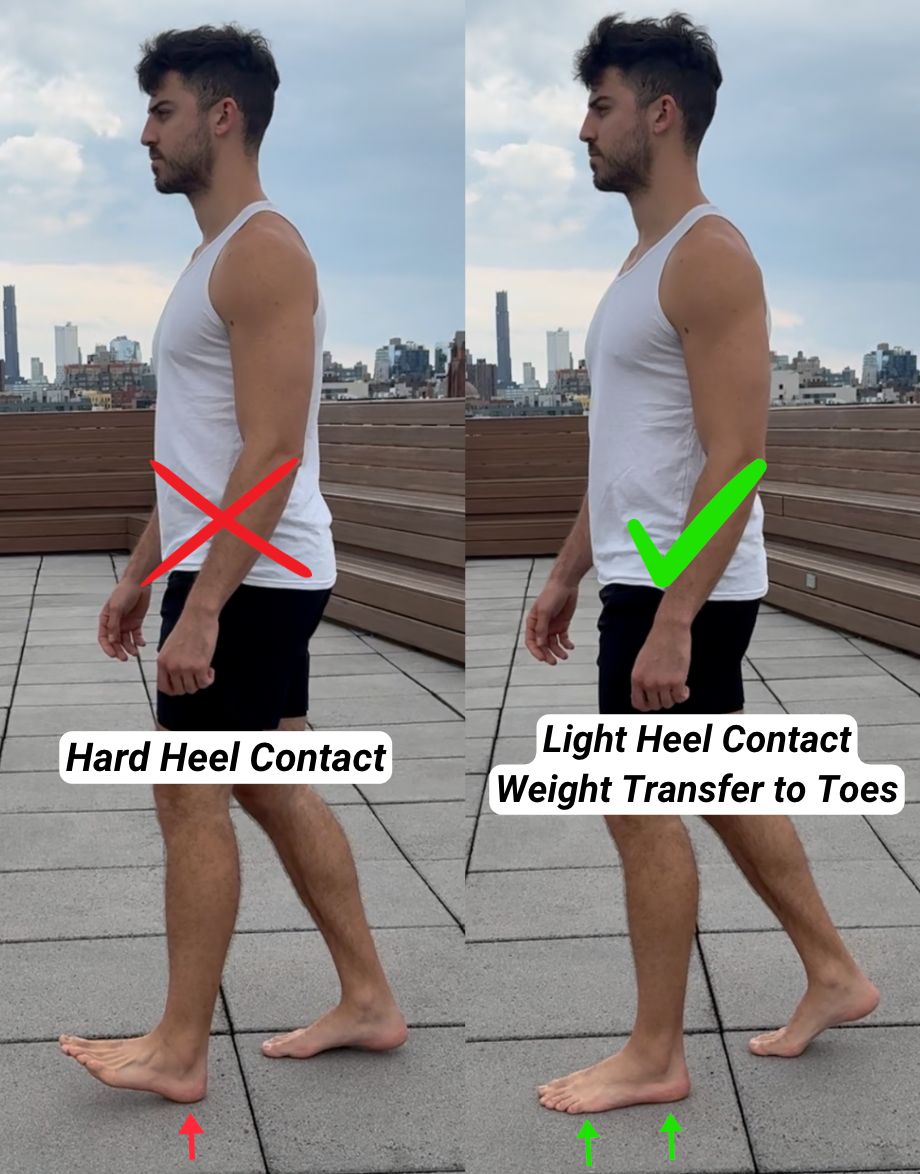
The key to walking well is straight feet, narrow stance, and light heel pressure. Keep the feet pointing forward and under you. Don't allow the feet to drift out or away from your center of gravity. As you push-off, make sure you're pushing over your toes or slightly inward, but not outward. No duck walking!


Spread the toes as much as possible and place your weight into the outer part of your foot and the toe pads. The heel can touch, but only lightly at first. Don't apply any force to the arch of your foot. Avoid heavy heel striking and think about keeping the knees and hips soft and landing lightly.
Walking comes from the mid back, not the hips. When you step forward with your left leg, your spine rotates and side bends to the left. The core and spine generates force and it’s distributed by the hips and legs. Coiling the spine is the primary source of power for when we walk, throw, and punch. Good walking involves rotation and swaying side to side, in the same way a fish, lion, and amoeba move. Learn to initiate your walk from your torso. Focus on extending both arms and legs behind you.


One way to improve how your upper body moves is to practice rope flow like the video below. This helps you to restore movement to the thoracic spine and shoulders, which is a commonly stiff part of the body.
Here are some additional videos that can help you on your journey to improving your walk:
Conclusion
Walking is one of the most complicated things that we all do, but many never stop to consider how they're doing it or if each step is helping or hurting them. Applying the tips I've shared in this article will help to ensure that walking is therapeutic and beneficial in keeping you healthy and pain-free.
If you want one-on-one attention to improve your posture and how you move, schedule a fitness consultation to get started working with me today.
Hope this helps! -Tom

Comments