How to Walk with Good Posture and Technique
Updated: Feb 17
Before learning these 2 things walking would cause me pain. In this post I share the simplest strategy for improving your walk.
Step 1: Foot Strike

Walk with straight and narrow feet directly under your hips. Spread the toes as much as possible and place your weight into the outer part of your foot and the toe pads. The outer part of the foot (lateral column) sits below the inner part of the foot (medial column), so we want to land with the outer part of the foot first when walking.

The heel can touch, but only lightly at first. Don't apply any force to the arch of your foot.
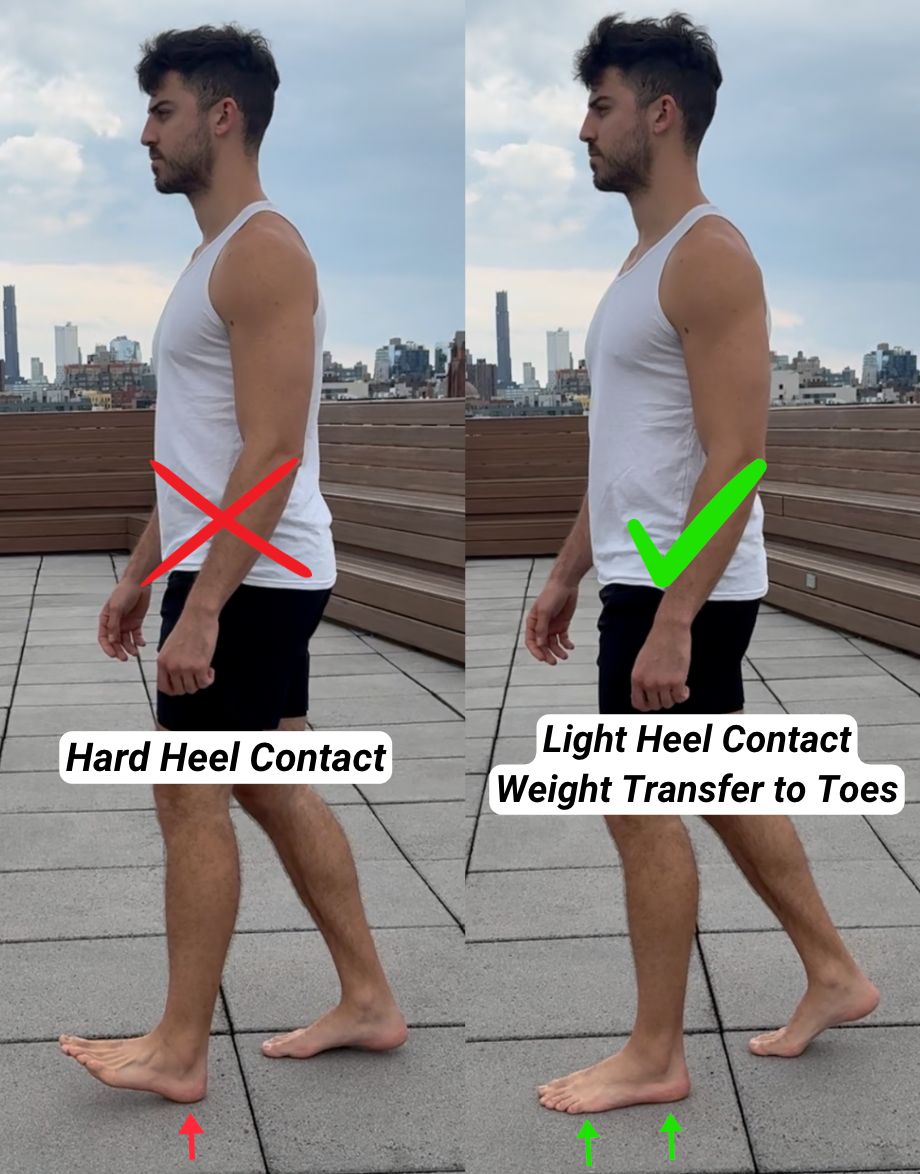
Keep the knees and hips soft as this helps to land lightly. If you're used to heel-striking you might have to slow down at first until you get comfortable walking with better technique.

The most common walking mistake is walking with the feet wide and pointing out. Don't allow the feet to drift out or away from your center of gravity. As you push-off, make sure you're pushing over your toes or slightly inward, but not outward. No duck walking!

The foot should land under the head when walking in order to maintain balance. You can accomplish this by maintaining narrow feet and by slightly coiling your spine (see step 2 below).

How you make contact with the ground is the most important part of walking well. Unfortunately, modern shoes shift our weight to the inner parts of the feet, limit our ability to use our foot muscles, force excess heel contact, reduce ankle mobility, create bunions, and strain the plantar fascia.


Be barefoot or wear flat and wide shoes to mobilize and strengthen the feet. Here are the shoes I use and recommend. Most people struggle with getting weight to the outer parts of the feet, so I recommend getting the SoleSteps to experience how standing should feel on the feet. I explain what these are and how to use them in the 2 videos below.
The gym often reinforces heavy heel-striking, so in order to have your training support your better walking technique, perform heel-elevated exercises and learn the drop-in exercise to build your plantar fascia to glute connection. Check out this article to learn ways to make common exercises more athletic.

Step 2: Spiral

Rotate your torso towards your front leg as you take a step. When you step forward with your left leg, your spine rotates and side bends to the left and then uses this coiled potential energy to take a step with your right leg. The spine generates the primary force for walking and it’s distributed legs.

The torso is the source of your power. Good walking involves rotation and side bending, in a similar way to how a baby crawls. The opposite shoulder and hip are connected with fascial slings that are the primary driving force for walking.


Look at any speed walking competition or sprint takeoff and you'll see a good amount of rotation and side bending as the torso is the primary source of our power.

The body moves efficiently by using our fascia to create elastic energy. Allow the knee to track slightly outside of the foot to use the strong fascia of the outer leg.

Striking the ground with the correct parts of the foot allows you to create an efficient spiral of energy that aligns the joints and maximizes force output, but it also absorbs force better leading to less knee impact.

In this way, the spine spirals and so too does the leg, creating an efficient system of torque to propel you forward during locomotion.
Core Stability vs Spinal Engine
The two mainstream conflicting theories of the spine come from Dr. Stuart McGill and Serge Gracovetsky, both influential spine biomechanics researchers, but with differing views. In essence, McGill advocates for spine protection through stability, while Gracovetsky focuses more on the spine's complex engine and movement capabilities. McGill sees spinal movement as inefficient while Gracovetsky sees spinal movement as efficient.


Most of my fitness career I followed the spinal stability and bracing core theory of Stuart McGill, and preached this to my clients, saying things like "When you run, you don't flop around because your spine is stiff and your limbs provide the power and movement." I believed that humans moved like robots - stiff spine and mobile limbs. One of the favorite phrases commonly used is "Distal mobility requires proximal stability" meaning that in order to move the limbs we must have stability at the spine.
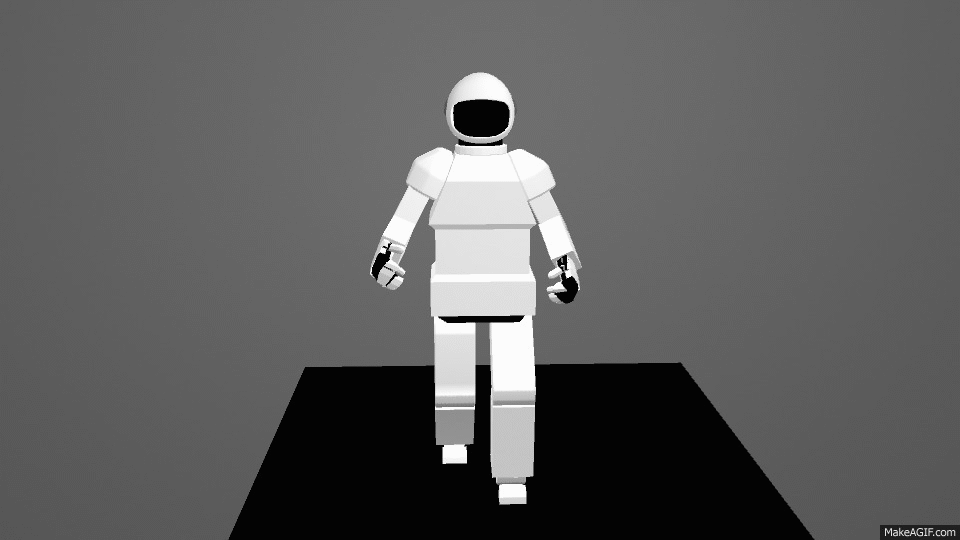
But then I moved from bodybuilding and powerlifting to athletics and helping people with chronic pain, and I started to notice that athletes don't move with spinal stiffness. Instead, the spine actually moves a decent amount, especially during running or walking. If you try to run without moving your spine, it feels awkward. See the below video for a contrast of spinal movement versus spinal stability.
Movements like throwing, swinging and running are impossible to do optimally with a braced core. Stiffening your torso and tightening everything around your spine to keep it neutral is functional for weight lifting, but you can’t throw, hit or move with speed and power when your core is braced to keep your spine neutral.
Core bracing and creating intra abdominal pressure is still helpful for certain things like lifting heavy weights during a deadlift, but this is not the primary way the human body generates power during athletic movement. In sports and in life, rotation is power, and side-bending is what creates this rotational power. Without side-bending, rotation of the spine is weak and stressful.
Conclusion
I used to have knee pain, peroneal tendonitis, and shin splints related to how I was walking and running. What I now know would have saved me years of wasted time seeing doctors and trying useless treatments. If this is your first exposure to the mechanics of walking, it might raise more questions than it answers. That's wonderful. Keep asking and searching to better understand your body and how it functions.
If you have questions, leave a comment below. For one-on-one coaching, schedule a fitness consultation.

Here are some additional videos that can help you on your journey to improving your walk:
Comments