Overcome Back Pain: Coordination Tests
- Nov 23, 2025
- 3 min read
Updated: Dec 3, 2025
A natural athlete moves from his hips, never from his back or knees. The following tests will assess your ability to move at your hips in an athletic way.
Breathe

If your breathing habits are faulty, you're much more likely to suffer from chronic pain because shallow breathing reduces blood flow to the spine and increases tension and stress. The primary breathing muscle is the diaphragm - connecting the bottom of your lungs to your spine. You can visualize and feel your diaphragm muscle pressing down into your abdomen as you breathe in.


The secondary breathing muscles are the intercostal muscles between your ribs that help to expand your rib cage and open your lungs - with each inhale feel your rib cage expanding out 360 degrees around your torso. The breath should be horizontal instead of vertical. Think about expanding out laterally instead of up and down.

Common mistakes include belly breathing without expanding the rib cage and shallow breathing without expanding the diaphragm. To breathe with good technique we need both habitually.

Find a comfortable position with a neutral spine, place your hands on your lower ribs, and inhale deeply to expand your torso. Breathe into your belly, sides, and back. Think of your torso as a cylinder and fill up every direction possible 360 degrees and then relax to exhale.

The o2 trainer by Bas Rutten is a tool that can help you connect with and train your breathing muscles. Inhale with force as deeply as you can and then relax to exhale. Practice taking 30 deep breaths 1 time per day to connect with your breathing muscles. I highly recommend this product.
Learning how to breathe has improved my ability to overcome simple ailments like stomach aches and headaches, and it’s improved my cardio and recovery abilities. Learn how to breathe and put in the effort and I guarantee you your life will improve.
Walk
Record yourself walking from the front, side, and back to look for these tips:
Feet point forward and don't turn out. Feet are under the hips and not wide or out to the sides.

Soft heel contact and transfer to the toe pads and outer part of the foot. The key to walking well is straight feet, narrow stance, and light pressure in the heels.
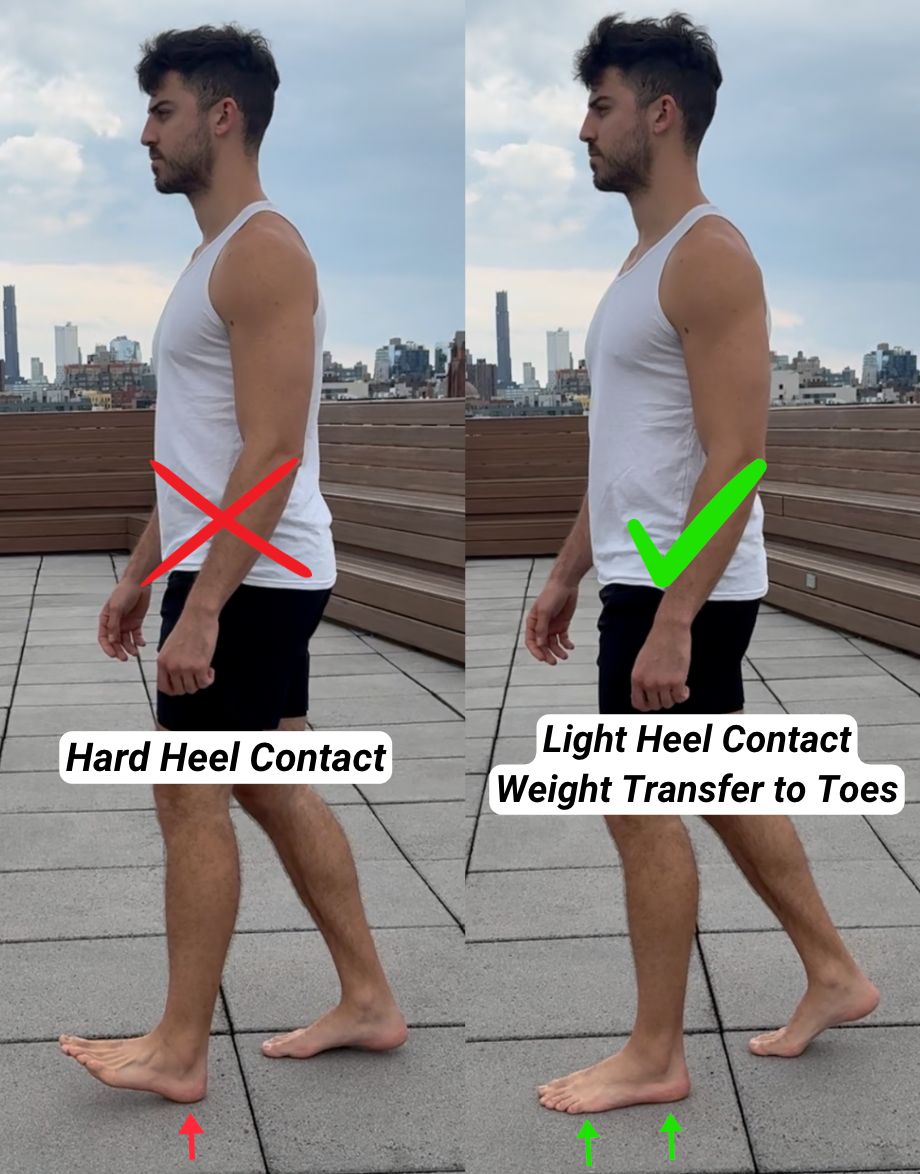


Arm swing and leg extension behind you, not only in-front. Neutral spine, not rounding or arching.

Feet extend behind as much as in front. Landing under your center of gravity, not over-striding or reaching in front of you with each step

The torso drives the body forward by creating a coil and rotational power. The force of walking comes from the mid back, not the hips. When you step forward with your left leg, your spine rotates to the left. The core and spine generates force and it’s distributed by the hips and legs. Coiling the spine is the primary source of power for when we walk, throw, and punch.

Squat
Record a squat from the front and look if your knees go anywhere other than over your toes. Record from the side to see if your spine is neutral or if you arch or round excessively.


Hinge
Record a hinge from the side and look if you're able to maintain a neutral spine as you bend forward or if you round or arch excessively. Movement at the hips, neutral spine. Hips roll forward, hands past knees. Symmetrical.

Lunge
Record a lunge from the front and look if your feet are stable, your front knee caves-in, or your hips rotate. Active foot, knee tracks outside big toe.

Single leg Squat
If the lunge looked good, record a single leg squat from the front and go as low as you can to see if your knee is stable or caves inwards. Active foot, knee tracks outside big toe.

Hip Airplane
Perform the hip airplane exercise to test hip control. Balance on one leg as you rotate at the hips. Make sure to move your shoulders and hips at the same time. Strong foot balance, movement at the hips and not the back. You can hold something for support if balance is insufficient.

Drop-in
Perform hip drop-ins to test foot to glute connection and coordination. This is the same as the hip airplane only you keep both feet on the ground with your heels elevated. Note if you're able to feel the glutes as you rotate. Strong foot balance, active glute connection while moving.

Conclusion & Next Steps
The insights from these coordination tests are pieces of the puzzle that is your chronic pain. If you identify one or more movements that are particularly challenging for you it means you have opportunity to improve your coordination. Using this information you can build a custom training program to address weak links. If you want help on your journey, schedule a fitness consultation to get started today.
Hope this helps! - Tom

Comments