How to Sit Better
Updated: Jan 4
Posture is how you hold your body against gravity. Better posture balances bones, while worse posture uses muscles and ligaments to hold you up. Try this: Place one hand on your low back and the other at the back of your neck and then round forward. You’ll feel these muscles activate. Now, lean back until you feel these muscles relax. Repeat this to feel how active your muscles are when your bones are not balanced.
This article is going to help anyone dealing with back pain related to sitting. I share why people sit poorly, how to sit better, options to sit less, and my personal experience with back pain related to excess sitting.
Why People Sit Poorly
Today most seats are designed to make you slouch and most people slouch. If most of your family and friends sit with poor posture, that becomes normal to you. If this habit is left unchecked, it can cause long term back pain like it did for me.
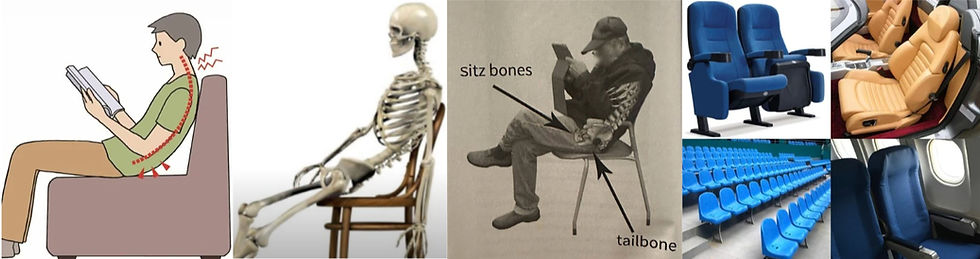
It took me a long time to discover the cause of my pain (sitting) because most people sit poorly, so I was normal. Although almost everyone sits with poor posture in unforgiving seats, only some people experience pain as a result of this. Since most doctors see the world from the view of structural (you're broken) instead of function (your habits are broken) you're unlikely to get help with this from anyone in the western medicine.
It's really quite simple: if you have pain after sitting or if you sit 10+ hours per day and have back pain, how you're sitting is a likely contributor. Below I explain how to improve this and overcome back pain from sitting.
How to Sit Better in 2 Steps
Most people think good posture is perfectly straight and requires effort and discipline, but that’s not true. Better posture requires the least amount of force to maintain. Good posture is balance, not force. Think of balancing your bones as you'd balance stones on top of one another.

Step 1: Neutral Spine
Neutral is a range, not one destination. When sitting or standing, find the position that requires the least amount of muscular effort to hold you up.

With a neutral spine, you won’t feel spine bumps as when rounding, or a deep spinal groove as when arching.

To find a neutral neck position, keep your nose below your ears.

The key to maintaining a neutral spine when sitting is to roll the hips forward so your base is your sit bones, not your tailbone.


Find a seat that places your hips slightly above your knees to make it easier to roll your hips forward. Sit on a wedge or tuck one or both legs under so that your knees are slightly below your hips and you’re able to easily roll your hips forward to maintain a neutral spine. If your seat is too high, place something under your feet.


Sit like a happy dog wagging their tail - don’t sit on your tail! This applies to all sitting positions.


Avoid crossing your legs, or if you must only cross your ankles to avoid uneven stress. Let your legs naturally open and spread your butt cheeks to widen your base of support and take stress off the low back. The seated goodmorning is a good exercise to teach correct hip position.


A lumbar support can alleviate the discomfort of sitting, but it doesn’t train you to maintain good posture without it and can cause excessive low back arching. This is why I recommend the stretchsit cushion over using a lumbar support.


In order to maintain a neutral spine when standing, our foundation must be strong and our hips, knees, and ankles must be stacked. Modern shoes squeeze our toes and force our weight to the inner parts of our feet, which causes dysfunction. Instead, wear wide barefoot shoes and place your weight in the outer part of your feet and toe pads. Slightly externally rotate your legs as if you’re trying to wrap your legs around you as this aligns your joints and makes it easier to position your hips well and maintain a neutral spine. The Sole Steps are a tool that teaches how to habitually shift the weight to the outer parts of the feet. Better posture is tall, but it’s not vertical - place your fingers where the legs meet the hips and gently push back to place your hips slightly behind you. Standing desks can help with posture, but you can still slouch while standing, so keep your feet wide and change positions often to avoid slouching.


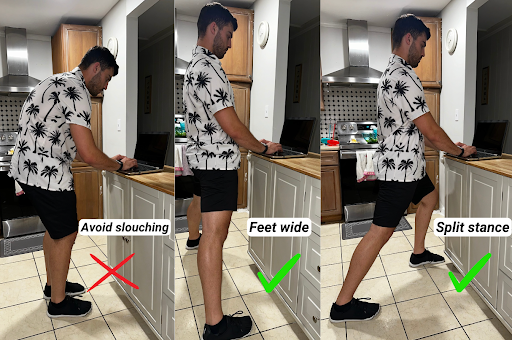
Step 2: Be Tall
Once you've found a neutral position, attempt to lengthen your spine as if you’re trying to get as much space between your hips and the top of your head. Don’t lose your neutral spine and make sure you keep your nose below the ears when lengthening.

Modern posture and sedentary lifestyle has changed the shape of the spine. Current medical illustrations depict good posture as having a tucked pelvis with big spinal curves (left), but modern sedentary lifestyle is the cause for these accentuated curves. Just a short while ago (1911) a straighter spine (right) was more common. The spine is designed to be straighter.

Our habitual postures are the primary contributor to muscle and joint tightness, so analyze your posture with this resource and work to improve how you sit, how you stand, and how you lie down and consider getting these posture books to learn more about posture and your body.
The most common posture mistakes are overcorrections. For example, most people have become terrified of “anterior pelvic tilt” so they push their hips forward and squeeze their butts, but this actually worsens their pain. Instead, the hips should be soft and slightly behind us. Other people believe that keeping their “chest up” is needed for good posture, but they overarch their low backs and worsen their pain. Instead, find a neutral position and focus on balance.


If you can get the hips and spine balanced and positioned well everything else tends to also balance. However, some people also benefit from thinking about externally rotating the shoulders. Reach back with one arm at a time like you’re trying to reach for something in the backseat of a car and then ‘anti-shrug’ your shoulders down to set your shoulder blades onto your rib cage. If you just can’t seem to improve your posture, consider scheduling a fitness consultation to work with me directly.
Specific Sitting Situations
On an Airplane
Read this airplane back pain survival kit. Place a cushion towards the back of your seat to get your knees above your hips and assist with rolling your pelvis forward. Use a stretchsit cushion or sweatshirt to support your mid back and assist with maintaining a long neutral spine. Take regular breaks to stretch your legs when you can.

At the Computer
Set your screen to eye-level if you can to avoid slouching.

Keep the shoulders back and down and only rotate your palms down to type.

A computer posture alternative is the half-kneeling position where you place a cushion under your knee and switch legs regularly to maintain a stretch in the hips and a long spine.

On a Bicycle
Sit with a long spine while riding a bicycle. Ground your pelvis, straighten your back, and relax your shoulders away from your ears.

On the Toilet
Spread your legs and roll your hips forward to maintain a straight spine to avoid straining your back. Tuck your legs under if the seat is too low. Good posture will also make your bowel movements easier.

How to Sit Less
The best posture is variety. If you must sit for extended periods, find multiple postures you can hold so you provide variety to your tissues. Sit on the floor to improve circulation and strengthen your hip, ankle, and knee joints. A nice rug or cushioned floor will incentivize you to sit/lie on the ground instead of on the couch. Here are some sitting postures you can use to add variety. Many of these can be used while working at your computer. Play around to find postures you like best.


My Experience
My back first started hurting when I was 10 years old and the worst part was nobody knew the cause. Each doctor I visited had a different structural explanation for the cause of my pain: scoliosis, bulging discs, spinal stenosis, degenerative disc disease. The problem was doctors were relying on scans but many of the abnormalities they point out cause zero pain in most people [Source].

The only way I was able to identify the cause of my pain was through personal study. I discovered that my long torso and legs made most seats poorly suited for my body, and my poor posture put stress on my spine and tightened my hip flexors creating unending pain. A primary component of becoming pain-free was learning to sit better and sit less. After working with hundreds of clients, I’ve discovered that most back pain is caused by how we use our bodies, not a mark on a scan.

Conclusion
This article helped to explain how to improve your sitting to overcome chronic back pain. If you want help learning about your body and creating a custom plan for you, schedule a consultation to work with me directly.
I hope this helps! If you have questions, leave a comment or send me a message!

Comments